RIOTS IN TETE
The European presence triggered multiple riots and resistance by the African populations. This documentation accounts for some of these and the concerted armed reaction between the Portuguese and the English since 1902 in Tete (Mozambique). It also tells of the rivalry between the Portuguese and the English over the collection of the "mussoco" or “palhota" tax [hut tax]. Once the exact delineation of the colonial border was unknown, both colonisers demanded these taxes from the same populations. Many black people changed the location of their villages from one side of the frontier to the other to escape these demands. This situation led to the European powers' urgent creation of the Southern Zambezi-Tete boundary commission (1904-1906).
Document 1
Memorandum by [Fernando] Matoso Santos, [Minister and Secretary of State for Foreign Affairs], for Minister and Secretary of State for Navy and Overseas Affairs.
Lisbon, 15-07-1901. Paper, 2 pp. manuscript.
Document 2
Letter (copy) from [Hugh] G. MacDonell [UK]
Minister in Portugal] to Fernando Matoso Santos, [Minister and Secretary of State for Foreign Affairs of Portugal].
Lisbon, 10-07-1901. Paper, 2 pp., typewritten.
Document 3
Memorandum by Tomás António Garcia Rosado, interim Governor General [of the Province of Mozambique], for Minister and Secretary of State for Marine and Overseas Affairs.
Lourenço Marques, 27-12-1902. Paper, 1 p., typewritten.
Document 4
Memorandum by Tomás António Garcia Rosado, interim Governor General [of the Province of Mozambique], for Minister and Secretary of State for Marine and Overseas Affairs.
Lourenço Marques, 28-12-1902. Paper, 1 p., typewritten.
University of Lisbon, National Museum of Natural History and Science, Border Archive Collection, Boundary Processes, Mozambique, Tete (box no. 38)
© PT-MUL-IICT-FRO-PF-MOC-38-01-002; 0016 and 0017.
Pink Map.
Charter of Portuguese Southern Africa / Cartography Commission, coordinated by A. A. d’Oliveira.
It was engraved and printed by Erhard Fre[re]s. - Scale 1:6000000. - Lisbon] : Cartography Commission,1886 (Paris: Erhard Fre[re]s Rue Denfert-Rochereau, 35).
© National Library. Public domain.
In the different versions of this map, pink colour was used by the Portuguese to demarcate their territorial claim, crossing Central Africa from coast to coast. The particularity of this version is that it outlines, in grey, some of the territories of different peoples crossed and divided by the border.
PHOTOGRAPHING AND CLASSIFYING
The decree-law published in the Diário do Governo of January 23rd 1900, instructed all the boundary commissions as to the "maximum convenience, for further reconnaissance, [of] taking photographic views of those boundary landmarks or pyramids, indicating in the photograph the azimuth and distances at which they were taken”.
This legal provision encouraged the systematic practice of photography. It promoted descriptive and accurate images of the landmarks and other elements, presented in albums, in thematic series of "towers", “signs", and "landmarks". The possession of arms was another provision of this diploma. Although military escorts accompanied all boundary commissions, possessing weapons by the heads of the commissions was indispensable. Firearms were used for hunting, warding off dangerous animals, and exercising domination. Colonialism was an arms affair.
Decree-Law was published in the Government Gazette on January 23, 1900.
(Selection of articles related to the production of photography)
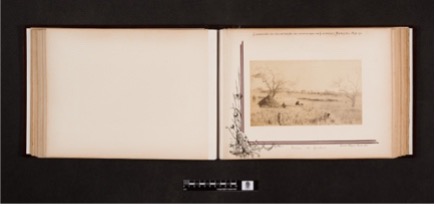
Boundary Delimitation Commission of Lourenço Marques, 1890-91.
Photograph by Andrade, Mezzena, and Serrano.
Photographic album with 38 albumin prints mounted on decorated cardboard.
© UL/IICT-MGG Photographic Collection-Alb3
The Cartography Commission was founded in 1883 and was the forerunner of the Tropical Scientific Research Institute, whose collections were integrated into the Museum of Natural History and Science of the University of Lisbon in 2015.
The photographic collection of the border commissions consists of 11 photographic albums and about 2000 negatives and prints. Comprising different photographic typologies, they are dated from 1890 to 1931.
***
AFRICAN RIOTS AND WARS
KNOWN IN PORTUGAL AS WARS OF PACIFICATION
Wars in the territory of Mozambique against Portuguese rule
Bongas’ War in Tete region (1841-1888)
Macombes Riots in Barué (1891-1902)
Namarrais War (1896-1913)
Battles of Chire and Macequece (1889-1890)
Battles of the empire of Gaza (1849-95)
Wars in the territory of Angola against the Portuguese domination
Humbes’ Riots, 1885-86
Cuamato’s Riots (Vau do Pembe, 1904; Portuguese counter-attack 1907)
Bondos’ Riots (1896-1917)
Quiocos’ Riots (1907-08)
Dembos’ Riots (1907)
Cubango’s Riots (1909)
New Dembo's uprising (1913) (Portuguese military campaign of Norton de Matos)
SOURCES:
Luís Almeida Martins, “The time of the centurions”, in Visão História: Origins and construction of the Portuguese Empire in Africa, 31st, October 2015, pp.66-73;
René Pélissier, History of the Campaigns from Angola, Editorial Estampa, 1986