Stories of forced recruitment and violence
The written reports of the border commissions narrate several episodes that testify to the violence, the arduous conditions in which local black populations lived, and the complex existing power relations. For several reasons, most of these stories found in reports were not photographed.
They were told from the colonisers' point of view as acceptable and even recommended. But we can see in them the opinions of those oppressed.
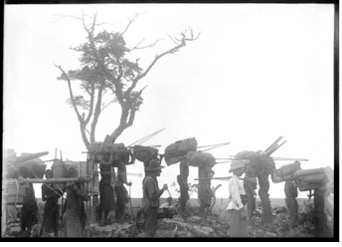
Commission for the Delimitation of the Southeastern Border of Angola, 1912-14.
Photography by Carlos Viegas Gago Coutinho [attributed]
Reproduction of original glass negative on gelatine and silver, 9x12cm.
© UL/IICT-CCart Photo Collection 24323
Photographs like this one witness the hard-working reality of black populations, to whom the most demanding jobs were destined. However, on the part of the colonialists, the accusation remained that they were lazy people incapable of caring for themselves. This was an argument to justify the colonial violence that aimed to force people to work and justified the expropriation of land from Africans considered “unproductive”.
Porters:
"Nothing seems valuable to us to say here, as the inconveniences of this means of transport have already been described many times. We should add that the difficulty in finding porters is increasing, a problem progressively spreading along Africa's east coast.”
Report by Freire de Andrade, op. cit., p.82
Laziness:
“That has a reason for being: the laziness of the Kaffirs and their selfishness. The first one who followed the path through the bush, at the smallest stone, the smallest bush or any tree fallen to the ground, surrounded it so as not to have the trouble of lifting it, and those who came behind followed his example”.
Report by Freire de Andrade, op. cit., p.15
Inside the frame:
“However, he did not find anyone there, as all the blacks fled when he arrived, and only by hiding in the bush could he manage to lay hands on a man, two women and some children, who were carrying supplies, despite all his promises, the kaffir always refused to accompany him, so that, following the instructions he received, he tied him up to bring him, the family fleeing on that occasion. When he saw that there was no possible resistance and that if he didn't want to go, he would have to go by force, he agreed or rather pretended to consent to come and serve as a guide and asked to go and leave the women in the village and return, leaving as a guarantee of what he said, the javelins and the groceries that the women had brought; only however, released, he fled and never appeared again.”
Report by Freire de Andrade, op. cit., p. 40
"As we approach, the village chief immediately rushes in, offering his services and a hut to spend the night; most of the time, they also bring a small gift. After some time, it is indeed recognised that these offerings are not voluntary; when they do not do so, the sepoys, soldiers or other officials and business people, who roam the country like veritable vanguens, oblige them by all means to show such deferences.
In addition to these impositions, another is imposed on the villages of the district of Inhambane, which is quite heavy; it is that of compulsory and free transport. When one of those entities arrives with loads to a village, it dismisses the porters it brought and gathers others who must transport them to the nearest town.”
Report by Mateus Serrano, op. cit., pg. 148
“The fear we had that they would run away was the only thing that until then had prevented us from showing them the way of life they needed to adopt.”
Report by Freire de Andrade, op. cit., p.16
“At Sabie, however, we were told that they didn't want to make a straw shelter for the two remaining horses and that besides, they didn't want to eat just rice, but that they wanted something else with it to make curry.
Our patience was exhausted, and because we were in the Transvaal and outside our sentimental laws, with the authorisation of the Boers, we had some strong arguments applied to the back of one of them, which for a long time afterwards kept them quiet and obedient."
Report by Freire de Andrade, op. cit., p.16
“However, we needed guides for our carts, and we asked the chief, he didn't have, as he said, who could send with us, and he said the same to Erasmus afterwards.
This one sent to the village, without warning us, to find out if it was true, meeting many people there; he ordered the chief to come, and having laid him down on the ground, he determined that twenty-five lashes should be applied to him. From our field, we hear the noise that this produced…”
Report by Freire de Andrade, op. cit., p. 22
“On one of these turns, we found a boy whom I forced to guide us to the village, but after accompanying us for half an hour, the rogue made us stop, saying that there was a goat in front of him, advanced with a javelin and disappeared”.
Report by Mateus Serrano, op. cit., pg. 120
"What a night! My sleep was short; weakness drove it away. At four-thirty on the 9th, I got up, got all the people to their feet and set out on the march, recognising that the guide Maâlane had fled and that the five Missassas [houses] made up the village were abandoned!"
Report by Mateus Serrano, op. cit., pg. 134
Big Frame
“After good manners, we moved on to threats, and I went with some armed negroes to search the kraals [villages], where, as I expected, I found nothing. It was all hidden in the undergrowth, very dense there, so that any search would be difficult; finally, having given the chief a crocodile as a gift on condition that he sell me a sack of corn for a pound, I brought it the next day.”
Report by Freire de Andrade, op. cit., p. 45
“The negroes refused to serve as guides in search of a river they didn't know existed, and only fear made the negroe Chetimella, who was leading us from Machengua, agree to accompany me”.
Report by Mateus Serrano, op. cit., pg. 104
“[Erasmus, chief of police on the Dutch commission] also complained about. There was no extradition treaty between Lourenço Marques and the Transvaal for criminal blacks, which prevented the kaffirs along the border from being reduced to obedience, who quickly moved their villages to either side of it.
Thus, Anyana, son of Maueva, after killing police officers in the Transvaal when they demanded that he observe the country's laws, fled to Lourenço Marques, with the Portuguese authorities coming to his aid. As a result, Anyana promoted disorders and robberies among the blacks of Maticuana along with Sabie and Komati, its predominance growing daily until it becomes a difficulty for Portuguese rule.
This fact has become a reality. Just a few days ago, the blacks of Lourenço Marques fled, startled by the news of a war brought and promoted by people like Anyana, who was recently deported to Mozambique”.
Report by Freire de Andrade, op. cit., p. 24