BLACK EMANCIPATION MOVEMENT IN THE FIRST REPUBLIC
In Portugal in the 1920s, Mário Domingues was the crucial precursor of new ideas aligned with the most far-sighted figures of the international black movement against racism and colonisation. As a journalist and activist, he provided perspectives consistent with Du Bois's “colour line” in denouncing black people's political, social and psychological condition and their specific history associated with slavery, the slave trade and colonisation. He understood, with a great pioneering spirit, modern colonial domination as “criminal colonisation” and was a forerunner in defending the ideal of independence for Africa from a confederal perspective. Mário Domingues knew how to support the postulate of equal rights for all human beings without neglecting that the emancipatory process does not only involve a moral or legal proclamation, its implementation being necessary considering social justice, knowledge and power.
Jose Luís Garcia
"Today, thousands of individuals know that black people are persecuted in Africa, that the abolition of slavery is an authentic lie and that Portuguese colonisation can only be designated by the word crime! (...)
All the crimes that, in the name of civilisation, have been committed in Africa have remained unpunished, buried in the shadow of oblivion, in the secrets of an accomplice State, a State that protects thieves and murderers. Because a bit of justice needed to be started to be done. For the honest opinion to condemn these crimes and try to avoid them, it was first necessary to publicise them."
Mário Domingues, A Batalha, July 25, 1922
 .
. 
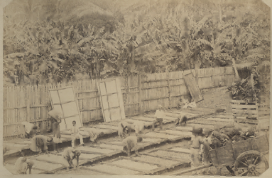
Cocoa drying yard in the Pinheira plantation - São Tomé. [Original caption]
African Gallery nº 1, 1st year. Photographs of West Africa by J. R. Gambôa, S. Thomé, [ca. 1885]
Reproduction of original albumin prints,13.2x20.4 cm, in an album.
© National Library of Portugal, public domain.
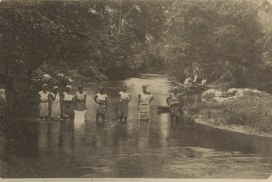
Laundry - São Tomé. [Original caption]
African Gallery nº 1, 1st year. Photographs of West Africa by J. R. Gambôa, S. Thomé, [ca. 1885]
Reproduction of original albumin prints,13.2x20.4 cm, in an album.
© National Library of Portugal, public domain.
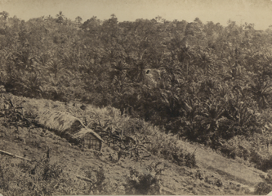
Palmar da Roça Boa Vista - São Tomé. [Original caption]
African Gallery nº 1, 1st year. Photographs of West Africa by J. R. Gambôa, S. Thomé, [ca. 1885]
Reproduction of original albumin prints, 13.2x20.4 cm, in an album.
© National Library of Portugal, public domain.
These photographs, published in an album of the late 19th century to publicise the economic progress of the colony of S. Tomé and Príncipe, end up testifying to the plantation economy implemented there, based on slavish forms of work. Mário Domingues revealed these injustices in his various articles. It was also the condition of his mother, from whom he was taken away as a baby.
MÁRIO DOMINGUES
FROM THE ISLAND OF PRÍNCIPE TO THE BLACK LISBON OF THE FIRST REPUBLIC
Mário José Domingues was born on July 3rd on Príncipe Island, in the archipelago of São Tomé and Príncipe, where sugar, coffee and cocoa cultivation were exploited by the Portuguese colonial economy using enslaved persons and forced labour. Mário Domingues died in 1977, in Lisbon, at the age of 77, so he still witnessed the regime's fall on April 25, 1974, and the subsequent end of the Portuguese empire and its colonialism.
Mario Domingues' mother was black, called Kongola or Monga, born in Malange, Angola, and was taken to the island of Príncipe when she was 15, forcibly hired to work in the Infante D. Henrique plantation, owned by the firm Casa Lima&Gama.
Mario Domingues' father, António Alexandre José Domingues, was a white Portuguese employee of that plantation. He brought the baby Mário Domingues with him at 18 months to Lisbon, where his paternal grandparents raised him in a middle-class environment that allowed him to study.
Mário Domingues took a commerce course at the old French College, attended by students from middle-class families. He witnessed fellow Africans such as Honório de Castro, from Guinea, who went on to become a lawyer, and Ayres de Meneses, from São Tomé and Príncipe, a future doctor, member of the Board for the Defense of African Rights and one of the leaders of his newspaper, Tribuna d'África, and of O Negro, spokesperson for the Black Students Association and the International Academic League of Blacks.
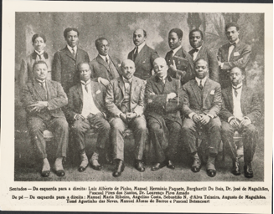
Members at the III Pan-African Congress, Lisbon, May 1923]
Sitting - From left to right: Luís Alberto de Pinho, Manuel Hermínio Paquete, Burghardt Du Bois, Dr. José de Magalhães ; Pascoal Pires dos Santos, Dr. Lourenço Pires Amado.
Standing - From left to right: Manuel Maria Ribeiro, Angelino Costa, Sebastião N. d'Alva Teixeira, Augusto de Magalhães, Tomé Agostinho das Neves, Manuel Afonso de Barros and Pascoal Bettencourt. [Original caption]
Reproduction of image collected by Mário Pinto de Andrade for his book
Origins of African Nationalism (D. Quixote, 1997)
© Fundação Mário Soares e Maria Barroso/Mário Pinto de Andrade Archive.
During the first republic, several organisations defending the human rights of black Portuguese men and women emerged in Portugal. Examples include the African League, the Association of Black Students, the Board for the Defense of African Rights, the African National Party, the African Nationalist Movement, the League of African Women, and the Ké-Aflikana Guild. The last two were organisations led exclusively by black women, such as Georgina Ribas, Maria d'Alva Teixeira, Maria Nazaré Ascenso, Ursula Cardoso and Angelina Praia, Portuguese black women's rights activists. This photograph signals the presence in Portugal of one of the central figures of the international Pan-African movement, the North American W. E. Burghardt Du Bois, who met with Portuguese activists. Further research on these activists, particularly these women, and more visibility of their actions are needed.
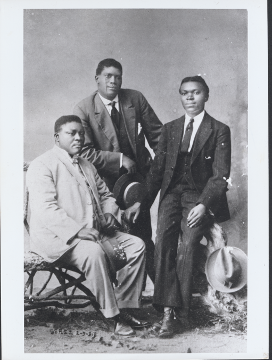
Doctor Ayres de Meneses (centre), flanked by Lázaro da Graça and Januário da Graça, in Portugal (c. 1918). [Original caption]
Reproduction of the original photo that is part of the documentation assembled by Mário Pinto de Andrade for his book Origins of African Nationalism (D. Quixote, 1997) © Mário Soares and Maria Barroso Foundation/Mário Pinto de Andrade Archive.
Ayres de Meneses was a São Tomé doctor and activist, one of the founders of the African students' newspaper O Negro, an example of the emancipatory press of Portuguese blacks.
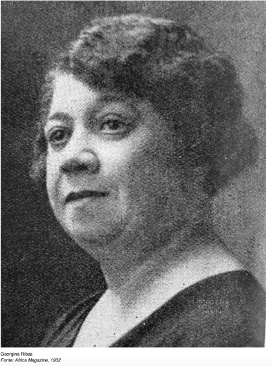
“It stood out (...) Georgina Ribas, a black feminist and leader of organisations such as the African National Party, the League of African Women or the Grémio Ké-Aflikana, and the latter, was evident in defence of black culture in Lisbon.”
Cristina Roldão, José Augusto Pereira and Pedro Varela, in “O Negro. A seed of the silenced black movement”. Commemorative leaflet for the 110th anniversary of the newspaper O Negro, March 9, 2021, p. 2.
Georgina de Carvalho Ribas (Ambriz, 1882 - Lisbon, 1951), daughter of a black Angolan mother named Culema and a white Portuguese father, was registered as the daughter of an incognito mother and educated in Lisbon by her paternal family. Graduated in piano from the National Conservatory of Music, she was a pianist, and music teacher, with a school in Rossio, a composer and musicologist and a central figure in the movement to affirm African culture and the emancipation of black women in Portugal. Her name is not documented in official archives; therefore, the images we find are of poor quality, indicating the invisibility to which these figures were put.
Vumbi 2: Mario Domingues
Rita Carvalho, 2021
Foldable narrative map measuring 44X62 cm illustrated with markers and printed in offset, in black on White paper. The map is part of a publication edited in the context of the anti-racist film festival MICAR (Santos; Camanho & Ferreira, 2021) and presents Mário Domingues (1899-1977), a journalist and writer who was in his youth a prominent voice of the Black Movement in Portugal. Beyond a tribute to his texts and the Movement itself, it was intended to point out its links with similar movements on the international scene. This is the 2nd Vumbi, a series of narrative maps about (de) colonisation.